
Home › Guides › Before the transplant
Guide · Step 1 of 5By Klineva · Updated on 5 October 2026 · 9 min read
The Norwood scale classifies male baldness into 7 stages. The Ludwig scale classifies women’s hair loss into 3 stages. They show where you are now and what may follow if the hair loss progresses. They do not, however, tell you why you are losing your hair. This page presents each stage in plain language, then looks at what these reference points mean for treatments and for a hair transplant.

Losing your hair, or not? Hair loss is far more common than it seems. It affects men and women alike, in different proportions and at different rates. In some men, baldness starts early. Its causes are many: genetic, hormonal or even linked to lifestyle. Scales are therefore used to measure this loss.
These are the Norwood scale for men and the Ludwig scale for women. Their role is simple. They make it possible to:
Alopecia does not present in the same way in men and in women. Because the hormonal factor is present, the loss does not look the same. That is why women refer to the Ludwig scale.
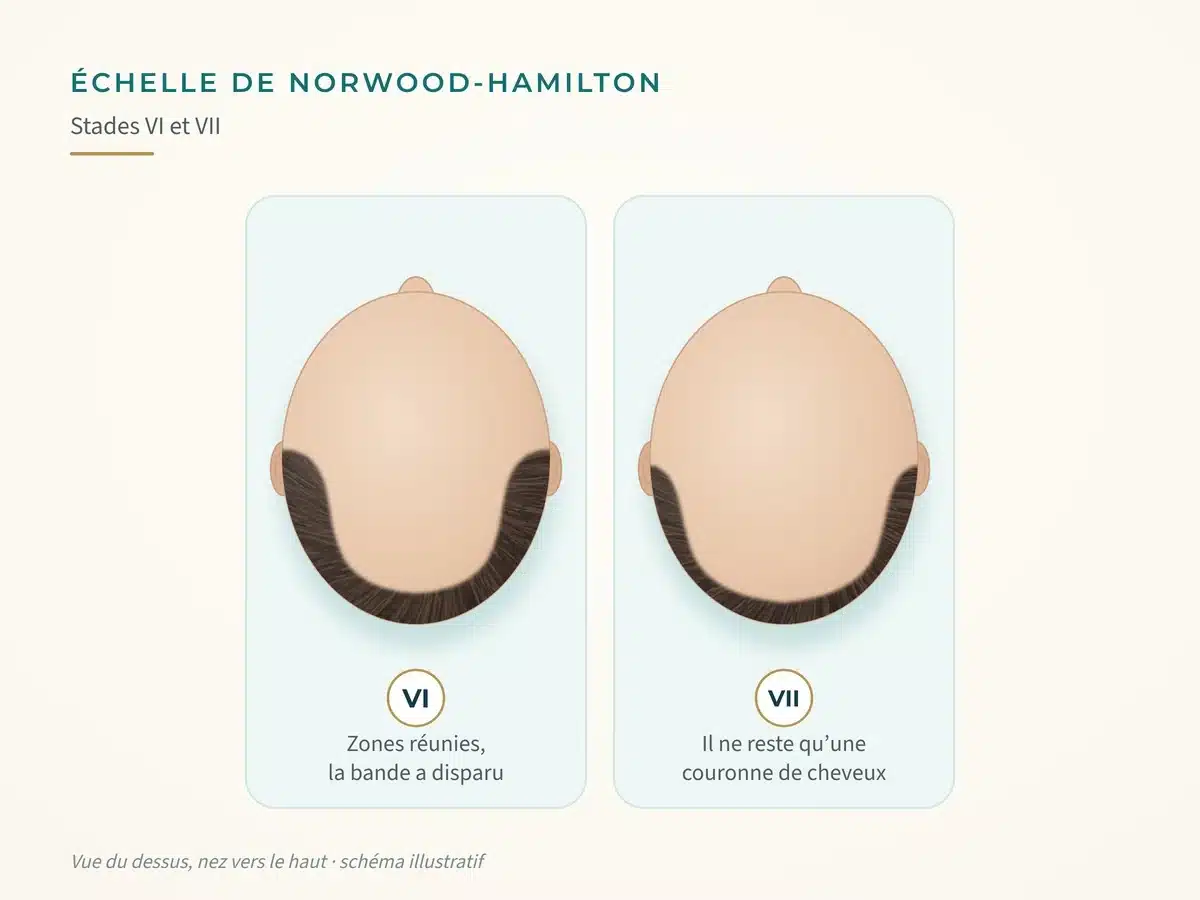
The Norwood scale, also called the Hamilton-Norwood scale, is used to grade male pattern baldness. It is a visual system that originated in the 1950s and was improved in 1975. It is still used today to identify the stage of alopecia. It has seven stages, from Norwood I (no hair loss) to Norwood VII (advanced hair loss). Healthcare professionals use it to adapt the treatments they offer.
Here are the stages in order, from the first receding of the temples to near-total baldness. Stage III also exists in a variant known as ‘vertex’, which affects the top of the head.


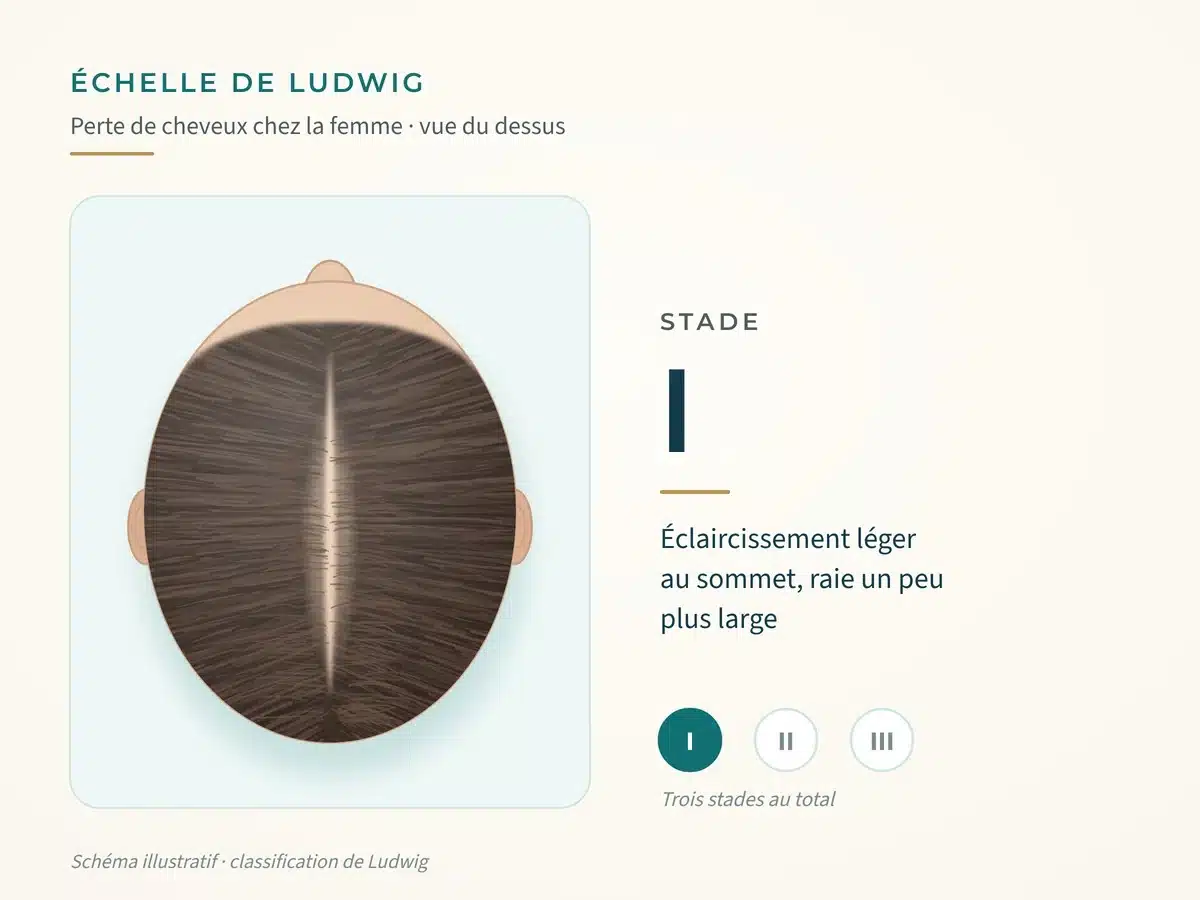
For women, the Ludwig scale is a tool similar to the Norwood scale: it is used to classify hair loss. It was created in 1977. Its author had noticed a steady increase in cases of alopecia in women and wanted to meet the needs of their patients. Unlike the Norwood scale, it has only three stages, from Ludwig I (diffuse thinning) to Ludwig III (severe hair loss). The classification is more complex in women, because there are many possible causes.

Note: this is only a general classification. Not every case of female alopecia follows the Ludwig stages exactly.
Ludwig I: at this stage, there is a slight loss of hair density on top of the head (the vertex). The central parting may look wider. A thin frontal border of hair remains, with almost normal density, of about 1 to 3 cm.
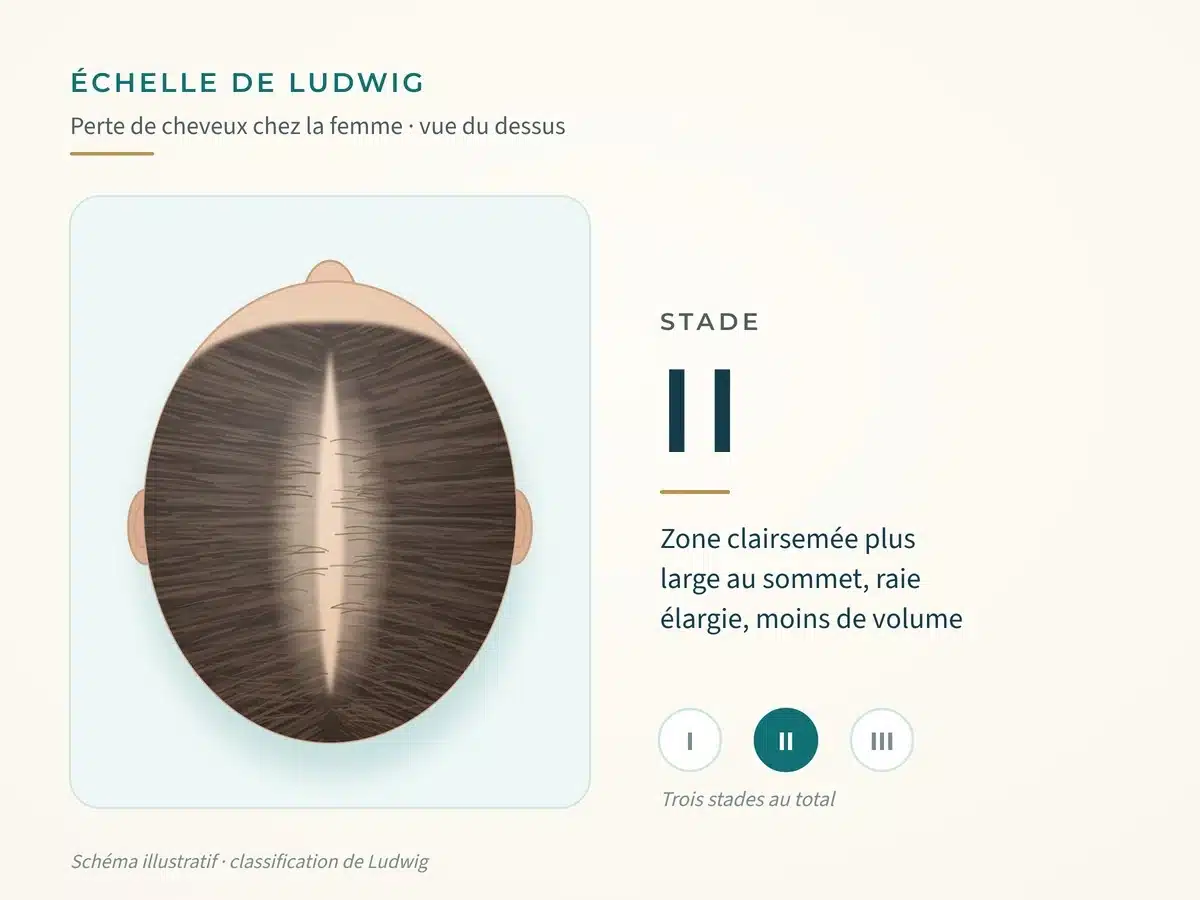
Ludwig II: the hair loss gets worse. A wider area of sparse hair appears at the top of the head, in the vertex area. Hair density and volume decrease all over, and the central parting becomes more obvious.
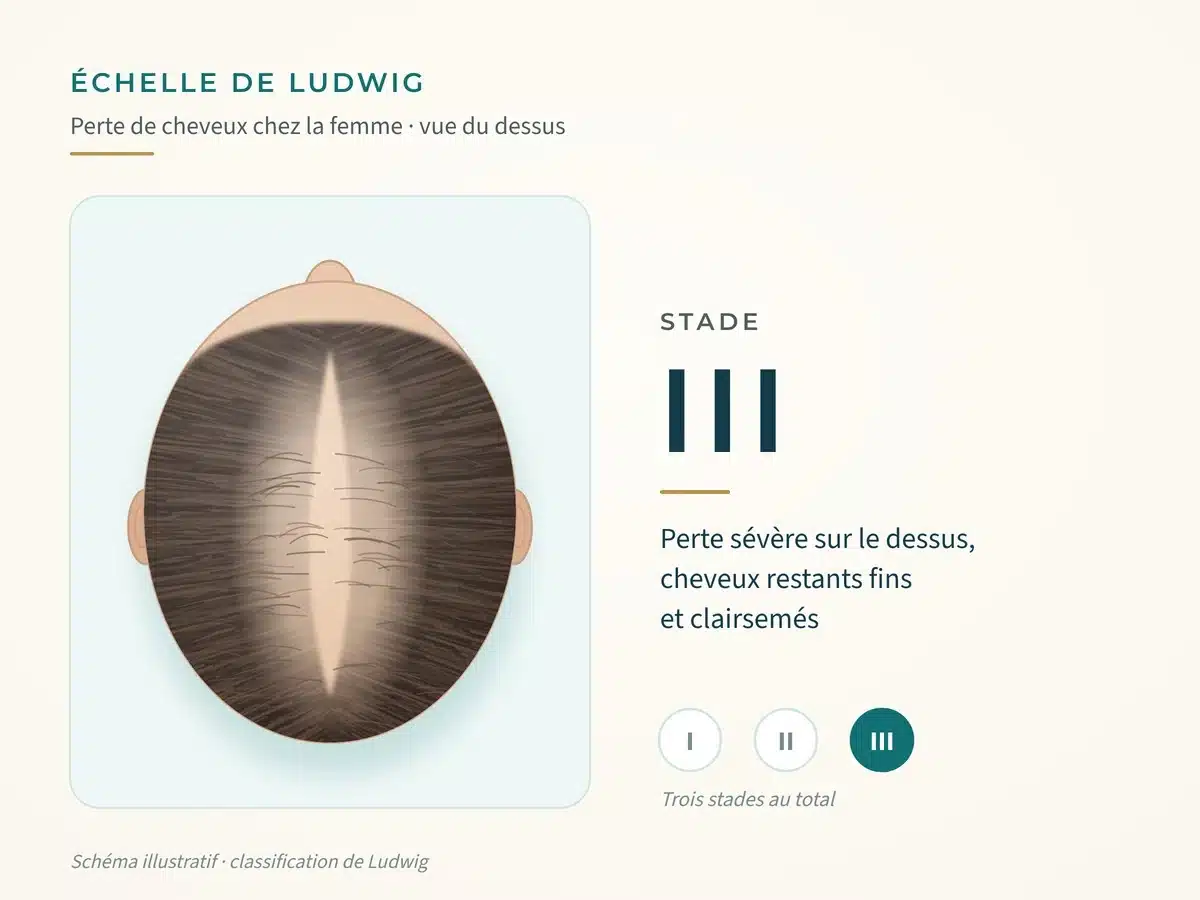
Ludwig III: this is the most advanced stage, with severe hair loss on top of the head. The bald area is large, and the remaining hair is sparse, almost downy.
No. According to the medical library StatPearls, these scales help to classify the severity of hair loss. They only classify the extent of the loss: they do not tell you why you are losing your hair.
The cause may be genetic, hormonal or linked to lifestyle. To find out what it is, you need an accurate diagnosis, made by a healthcare professional. It then makes it possible to offer treatments suited to each patient.
At Klineva, you can request a free diagnosis from our specialist: all you need to do is send a few photos.
Alopecia is not necessarily inevitable. Medication and a healthy lifestyle can help to slow hair loss. The guide on hair loss treatments gives an overview.
From stage II of the Norwood or Ludwig scale onwards, a hair transplant starts to be considered. This is especially true if the hair loss has stabilised. A transplant can address established baldness, but it is not always an option at the final stages. Only an examination of your case can tell you what is possible. In general, the earlier you act, the better your chances of preserving your hair in the long term.
There are several techniques, such as DHI, FUE, Sapphire FUE or no-shave hair transplants. The guide FUT, FUE or DHI: which technique should you choose? introduces them, and When should you have a hair transplant? helps you choose the right time. For women, there is a page devoted to hair transplant for women. If you are considering a transplant in Turkey, see how to choose a clinic.

real patients, with the number of grafts and the time elapsed since surgery
step 1 of 5: before the transplant
 Guide · Step 1When should you have a hair transplant?The right time to get started, from the season to the stage of hair loss.Read the guide
 Guide · Step 1FUT, FUE or DHI: which technique should you choose?The three techniques compared, without the jargon.Read the guide
 Guide · Step 1Hair loss treatments: what works, what doesn’tFinasteride, minoxidil, what’s new: sorting what works from false promises.Read the guide
 French French
 English
 Polish


