Home › Guides › Choosing the right clinic
Guide · Step 2 of 5By Klineva · Updated on 5 October 2026 · 14 min read
Hungary or Turkey for a hair transplant? Based on the public prices recorded in September 2026, Turkey generally offers lower prices than Hungary and France, and DHI is offered there more often. Hungary is closer: just over 2 hours by air from Paris, against about 3 hours 30 minutes for Istanbul. The right choice depends on your budget, the technique you want and the language, but above all on the clinic. Here are the prices, the care, the travel and what the forums say, followed by the questions to ask before you book.

Here are the public prices found online on 28 September 2026 for Budapest, Istanbul and Paris. These are headline prices, some of them promotional: only a quote will give you the price of your transplant. Turkey is generally known for its attractive prices, often lower than those in Western Europe. Hungary also offers competitive rates, but generally a little higher than in Turkey.
| Country | Prices recorded | Often included |
|---|---|---|
| Hungary (Budapest) | €1.50 to €4.40 per graft, depending on the clinic and the pricing tier | Consultation, medication, check-ups over 12 months; sometimes hotel and transfers |
| Turkey (Istanbul) | Around €1,900 to €3,500 for a standard package (FUE, Sapphire FUE, DHI); €6,000 to €7,000 at the top end | 2 to 5 nights in a hotel, transfers, interpreter, medication, post-operative kit, sometimes PRP (platelet-rich plasma) |
| Klineva (Istanbul) | Our packages start under €3,000 | Sapphire FUE or DHI, 2 nights in a 4★ hotel, transfers, interpreter, PRP, medical wash the next day, follow-up for 18 months |
| France (Paris) | Around €3,000 to €9,000 depending on the number of grafts, up to €14,000 for very large sessions | Procedure, post-operative kit, follow-up check-ups |
Public prices of clinics in Hungary, Turkey and France, recorded online on 28 September 2026; Klineva: klineva.com, September 2026. Sources at the bottom of the page.
One example advertised in Budapest: €3,200 for 2,000 grafts, at €1.60 per graft. Some packages priced per hair, promotions included, range from €1,600 to €6,000. Always compare for the same number of grafts. A graft is a small group of 1 to 4 hairs, taken from the back of the head. A headline price often applies only to a small number of grafts.
PRP is worth comparing too. In Paris, a stand-alone session costs €350 to €500 (the usual range in France). Some Istanbul clinics include it in their package; at Klineva, it is included in all our packages.
In Budapest, several clinics count in hair, not grafts: the figure advertised is therefore higher. In Istanbul, some packages are fixed-price, whatever the number of grafts. To compare, ask every clinic for the number of grafts and the total price in euros, in writing. The details of a package in Turkey are in our guide to hair transplant prices in Turkey.
The quality of care is an essential criterion, and both countries are known for their cosmetic clinics. Turkey has nevertheless carved out a leading place in hair transplants, with a large number of clinics dedicated to them. FUE, in which grafts are extracted one by one, is practised there, as is Sapphire FUE, which uses sapphire blades. You will also find the DHI, in which grafts are implanted directly with a pen (the Choi pen).
In Hungary, better known for dental care, you will also find good clinics, but perhaps less choice. Most of those we looked at offer variants of FUE, and DHI is offered less often. To compare the methods, read our guide FUT, FUE or DHI: which technique should you choose?.

The training and experience of surgeons vary from one country to another. In both countries, the reputation of the clinic and its surgeons matters. In Turkey, several doctors have international experience, because they have treated many foreign patients. In Hungary, practitioners are also qualified, but hair transplants involve fewer patients from abroad there, which can affect overall experience.
A hair transplant in Budapest or Istanbul is also a trip. On distance, Hungary has the advantage: from Paris, Istanbul is about 3 hours 30 minutes by direct flight, against just over 2 hours for Budapest. Depending on the season and the airline, tickets to Istanbul nevertheless remain affordable. The essentials, departing from Paris:
| Departing from Paris | Budapest | Istanbul |
|---|---|---|
| Direct flight | Around 2 hours 10 minutes to 2 hours 20 minutes (Air France, easyJet, Wizz Air) | Around 3 hours 20 minutes to 3 hours 45 minutes (Turkish Airlines, Air France) |
| Formalities (French traveller) | European Union: valid ID card or passport | No visa for up to 90 days in any 180; ID card or passport valid for at least 6 months after entry (Klineva requirement) |
| Currency | Hungarian forint (HUF): Hungary does not use the euro | Turkish lira (TRY) |
| Time | Same time as in Paris | UTC+3 all year round: 1 hour ahead of Paris in summer, 2 hours ahead in winter |
| Time spent there | 1 or 2 days of surgery, depending on the volume | 3 days with Klineva |
Sources at the bottom of the page (airlines, UK government travel advice, European Commission, Wikipedia), checked in September and October 2026.
Before you book, read the UK government’s foreign travel advice for Turkey or for Hungary – it sets out up-to-date entry requirements and safety advice. For the next step, read our advice on preparing your trip to Istanbul from France. Our article on Istanbul as a holiday destination also helps you plan some sightseeing before the operation.
Before choosing a clinic in Hungary, many patients turn to forums. This is a good idea, provided you know how to read them.
Without claiming to summarise everything, here are topics found in patient accounts:

Five criteria can help you decide:
Look for well-rated clinics, read online reviews and ask your questions: a good clinic will answer without difficulty. Also ask for several quotes so that you can compare them.
The key points are in our guide on how to choose your clinic – and if a result worries you, the one on a failed hair transplant will reassure and guide you.
A hair transplant is a surgical operation. The team takes hair follicles from a donor area at the back of the head, then transplants them into the thinning areas to restore density.
The first step is always a consultation. You discuss your expectations and the doctor assesses your scalp. It is a bit like a first date: you get to know each other before taking the plunge. A reputable clinic carries out blood tests and checks your medical history to make sure you can have a transplant (see our article on when hair transplantation is not recommended).
On the day of the procedure, the team guides you through every step. The transplant can take several hours. Local anaesthetics are used during the procedure.
After the transplant, post-operative care is needed. You will receive detailed instructions on what to do (and above all what not to do) to support the regrowth of your new hair. Choose a clinic that provides follow-up after the operation.
Here are four results from Klineva patients, with the technique and the number of grafts. Every case is different.

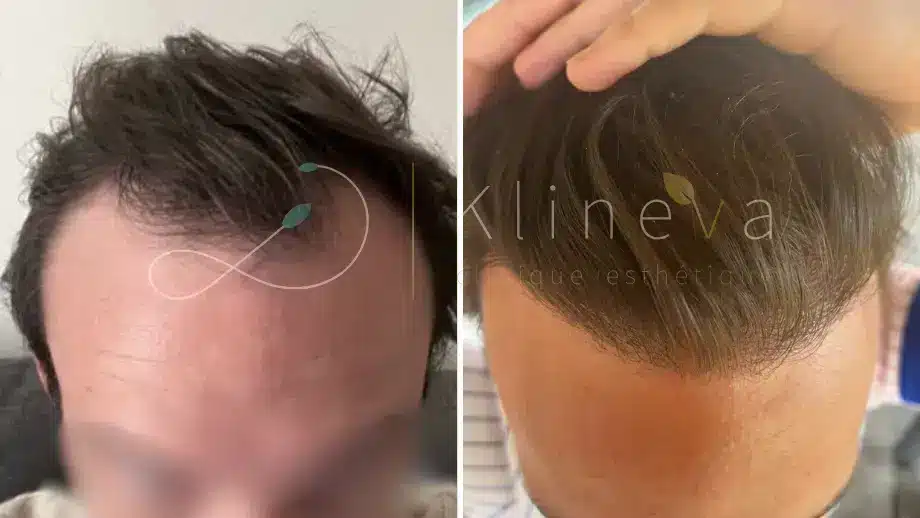


Having a hair transplant abroad can seem daunting at first, but many patients consider it. Costs in Turkey and Hungary are generally lower than at Western clinics. In France, the price depends on the number of grafts implanted and on the technique; in Turkey, you are more likely to be offered all-inclusive packages. Take care, though, to choose your clinic carefully.
In a good clinic, results are generally very natural. Once regrowth is complete, it is generally hard to tell where the natural hair ends and the transplanted hair begins.
Having thicker hair can help you feel more at ease in social situations and in your professional life.
Many patients prefer to keep their plans private: you do not necessarily want to tell everyone that you are having a cosmetic operation. Clinics abroad are often used to welcoming international patients. You can therefore have the operation without drawing attention in your home country.
A trip abroad is also a chance to enjoy the destination. We do advise sightseeing before the operation, not after. Budapest, the pearl of the Danube, and Istanbul, the gateway to the Orient, have different charms and a particularly rich heritage to offer you.
Turkey and Hungary are not the only destinations. In Belgium and Switzerland, clinics also advertise headline prices. Examples: €3,495 for FUE in Belgium (indicative price), “from CHF 1,500” in Geneva and “from CHF 8,000” in Lausanne (2024 page). A Budapest clinic also has branches in Prague and Bratislava. Our guides compare prices in Belgium and Turkey then in Switzerland and Turkey.

Wherever you go, the NHS advises you to make sure you understand the language in which the team explains the procedure to you, and to find out about the follow-up on offer.
real patients, with the number of grafts and the time elapsed since surgery
step 2 of 5: choosing the right clinic
 French French
 English
 Polish