
Home › Guides › After the transplant
Guide · Step 5 of 5By Klineva · Updated on 5 October 2026 · 16 min read
After a hair transplant, almost everything that worries people is to be expected. The forehead can sometimes swell around the second or third day, then scabs and itching follow in the first week. After that, the transplanted hairs fall out: it looks like a failure, but it is not one. This guide follows the first 30 days, period by period: what you will see, what to do, what to avoid and when to write to the team. It draws on the clinic's instructions and on medical sources; the protocol to follow to the letter is on the page Post-operative instructions.

A quick key to the dates: surgery day is day 0, the day after is day 1 (the third day of the stay in Istanbul), and so on. The table gives the essentials for each period; the sections below go into more detail.

| Period | What you see | What to do |
|---|---|---|
| Surgery day to day 3 | Tightness, light bleeding, sometimes a swollen forehead (peaking around day 2 or 3) | Neck pillow, plenty of water, first wash at the clinic on day 1, then one wash a day |
| Days 4 to 10 | Scabs, itching, mild redness; any swelling goes down | One wash a day, no scratching, first follow-up around day 7 |
| Days 11 to 30 | Scabs fall off (none left by day 15), sometimes spots; the transplanted hairs start to fall out | After the first 15 days: 3 to 4 washes a week; no exercise before day 30 |
| Months 2 and 3 | Sparse-looking area: the most discouraging phase | Patience, photos, questions for the team |
| From the 3rd month | First new hairs, then increasing density | Questions for the team during the 18-month follow-up |
Averages only: the pace varies from patient to patient.
A recovery that departs a little from the table (a barely swollen forehead, redness that lasts longer) is nothing to be alarmed about in itself. Only the warning signs listed below matter.
When the local anaesthetic wears off, the head feels tight and sometimes a little sore: the NHS describes a tight, tender and swollen scalp for a few days. The discomfort is most often mild. The back of the head, where the grafts were taken, can also feel tight, and it should not be touched either. Slight bleeding is possible at first; heavy bleeding after the operation is rare.

Swelling is uncommon if the instructions are followed. A review published in 2026 in Frontiers in Medicine nevertheless records a swollen forehead in nearly one patient in two. When it occurs, the swelling sets in one to two days after the operation, peaks around day 2 or 3 and subsides around day 5 to 7. It sometimes spreads to the area around the eyes (3 to 5 patients in 100), and a light bruise, purple then yellow, can last up to 10 or 15 days.
At Klineva, the first wash takes place at the clinic the day after the operation (day 1), with a post-transplant treatment of light therapy depending on the package chosen. PRP (platelet-rich plasma), on the other hand, is included for all patients, whatever the package: it is done on the day of the operation. PRP uses your own blood platelets, and light therapy uses red and blue LED light. This first wash matters. According to the same review, a late first wash, after more than three days, goes hand in hand with more spots and more pronounced redness.
The first few nights are often short and uncomfortable: sleeping on your back with your head raised does not come naturally to many patients. For most, it is the most restrictive part of the first days.
From these first days on, write to the team if bleeding does not stop. Do so too if the pain increases instead of easing, or if the swelling grows after the third day (full list below).
Any swelling goes down, and the scabs take over. According to the 2026 review, they form within the first two or three days around the grafts. They fall off by themselves during the first 15 days. The clinic sets a target: no scabs left by day 15. Scabs and itching are among the usual effects listed by the Cleveland Clinic. It also explains that after any injury, the body releases molecules such as histamine, a source of inflammation and itching.

Redness around the grafts is common and usually fades within two to four weeks, according to the 2026 review. In a study of 1,090 patients, it was mild in about 16 patients in 100, moderate in 5 in 100 and marked in fewer than 1 in 100.
In the mirror, the area then looks like a field of tiny red dots and dark scabs, sometimes on a forehead that is going down. It is not pretty, but it is the picture to be expected at this stage.
Around the fifth or seventh day, the grafts are anchored more firmly: they are no longer at risk of coming out at the slightest touch, although you should still avoid scratching. Around day 7, the team does a first follow-up with you. At this follow-up, the clinic checks the state of the scabs. The washing sheet puts the end of the course of medication at around the same date (always follow the prescription given to you by the team). It is a good time to ask your questions.
Write to the team if the redness spreads, becomes hot or painful, or if a cloudy fluid oozes out.
This is the period when the scabs disappear. The clinic places the end of healing at around day 15: by then, there should be no scabs left. If any remain at day 15, contact your medical adviser. The 2026 review also recommends having persistent scabs examined. After the first 15 days, washes go down to 3 or 4 a week.

Small red spots around the grafts appear in about 12 patients in 100 in a large study cited by the same review. They indicate folliculitis (inflammation of the follicles) and occur mostly between the first and fourth week. A few isolated spots are common; numerous spots, or spots that are hot, painful or discharge pus, are a reason to write to the team, with a photo.
Next comes the stage that makes the greatest impression: the transplanted hairs fall out. This is shock loss, a temporary shedding. You will find some during washes, on the pillow or on your clothes: this is normal and in no way permanent. According to the American Academy of Dermatology, this shedding happens between two and eight weeks after the operation and remains normal. The root stays in place, waiting to produce a new hair, the ISHRS explains. According to StatPearls, an online medical textbook, the first new hairs generally appear after three to six months. Neighbouring hairs that were not transplanted can also fall out for a while, the same source adds. The phenomenon is covered in detail in the article on shock loss.
Altered sensation or numbness in the transplanted area is nothing unusual. In a follow-up study of 152 patients, 10 patients in 100 had it at day 7 and 1 in 100 at six months. The 2026 review places complete resolution, in general, at four to eight months.
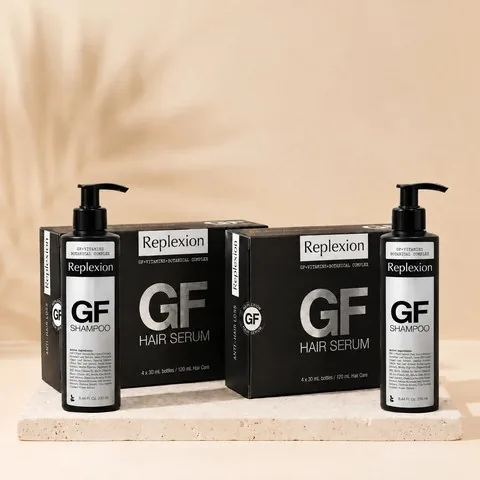
At day 18, the clinic's washing sheet also allows, as an option, for starting the GrowthFactor serum, a treatment we recommend, without promising any effect.
The great majority of after-effects are harmless: infection is rare, fewer than 1 patient in 100 according to the 2026 review. The signs to know are those cited by health authorities and hospitals for any surgery. If in doubt, write to us: no question is ever one too many. At the slightest worry, you can always contact your medical adviser.
| Normal | Report to the team |
|---|---|
| Swollen forehead, peaking around day 2 or 3, then going down | Swelling that increases after the peak, especially with redness, heat or pain |
| Slight bleeding in the first few days | Bleeding that persists or starts again |
| Tightness, mild discomfort that eases | Sharp pain, or pain that increases instead of easing |
| Scabs falling off, mild redness | Redness that spreads; scabs still there at day 15 |
| A few isolated spots | Numerous spots, painful or with pus |
General guidelines, not to be used for treating yourself.

A fever that does not go down, cloudy or yellow-green fluid oozing out, sharp redness and pain: these are signs of infection. They call for prompt advice, as the US CDC and the Cleveland Clinic both point out. Write to your Klineva advisers by WhatsApp or email, with a photo if possible. If you cannot reach them and are worried about your condition, see a doctor or go to an emergency department near you.
A useful message takes just a few lines: which day you are on (day 5, day 12…), what you are seeing, and since when. Add two or three clear photos, taken in daylight. The more precise it is, the quicker and more suitable the reply.
The clinic sets precise time limits; here are the ones people ask about most. The rest (cap, helmet, swimming in the sea…) is on the instructions page. That page also asks you, during the first 15 days, to pay attention to the weather (sun, UV, rain) and to maintain a healthy lifestyle.
And work? According to the clinic, you can go straight back to it, as long as the instructions are followed. A job that involves a helmet, dust, heat or physical effort needs to be planned in advance with the team. This is done even before choosing the date of the operation.
Many patients describe the same rollercoaster. In the first days, relief: it's done. Around day 10, the mirror disappoints: red forehead, scabs, a sparse-looking area. When the transplanted hairs start to fall out, the shedding feels like a step backwards, and in months 2 and 3 some people feel thinner on top than before. The American Academy of Dermatology is blunt about it: in the third month, the hair can look thinner than before the transplant, and this is normal.

Do not compare yourself with other people's photos. Every scalp heals at its own pace. Hair grows by about 1 cm a month according to the ISHRS: the final result takes between 12 and 18 months. A photo taken on the same day each month, in the same light, shows the progress better than the morning mirror.
Above all, remember that this dip is expected: the shedding is temporary and the root stays in place. If doubt sets in, talk to your advisers rather than brooding alone.
What helps, in practice:
After the first month, the most important part happens under the skin. The first new hairs generally appear from the third month; the NHS suggests the fourth instead. According to the American Academy of Dermatology, most patients see a result between 6 and 9 months, and some wait 12 months. The page Hair transplant month by month describes each stage. According to that page, growth speeds up from the fourth month. Density and volume keep increasing for up to a year, and the final result can be seen between 12 and 18 months.
In the meantime, five things are enough:
Still preparing for your transplant? The free diagnosis lets you send photos of your scalp and be contacted within 24 hours by an adviser.
real patients, with the number of grafts and the time elapsed since surgery
step 5 of 5: after the transplant
 Guide · Step 5Post-operative instructionsThe medical team’s instructions, on one clear page.Read the guide
 Guide · Step 5Washing your hair after a transplantThe washing steps, how often to wash and the team’s video.Read the guide
 Guide · Step 5Sleeping after a hair transplantPosition, pillow, duration: protecting your grafts well at night.Read the guide
 French French
 English
 Polish


