Home › Guides › Choosing the right clinic

Guide · Step 2 of 5

Failed hair transplant: signs, causes, what to do and how to avoid it

By Klineva · Updated on 11 October 2026 · 13 min read

Did you have your hair transplant a few weeks ago, and now your hair is falling out? Or have several months passed and the result disappoints you? Perhaps you have not had a transplant yet and some patient accounts have worried you. Take a breath: most of the time, what looks like a failure is a normal stage of a regrowth that stretches over a year or more. A result can sometimes be genuinely disappointing, but its causes are known, they can be avoided from the preparation stage, and there are solutions. This guide helps you tell a normal phase from a real problem, understand the causes and, if you are already affected, know what to do and in what order. At Klineva, you are not on your own: an adviser supports you.

Bright still life on a light oak table: a folded linen towel, a wooden comb, a ceramic dish and a sprig of eucalyptus.

No results after 3 months, hair falling out: is this normal?

Most of the time, yes: it is what is expected. A hair transplant does not show its result the moment you leave the clinic: the transplanted hairs fall out, the area looks thinner than before the operation, and then nothing happens for weeks.

Between 2 and 8 weeks after the operation, the transplanted hairs fall out: this is expected, according to the American Academy of Dermatology. Only the hair itself is lost: the root stays in place under the skin, the ISHRS (International Society of Hair Restoration Surgery) explains, and usually produces a new hair. Some of your original hairs next to the grafts may also fall out for a while: this is known as shock loss. This hair loss is temporary, and the new hairs usually reappear after 3 to 6 months, according to the StatPearls medical reference.

After the operationWhat to expect
First 2 weeksRedness, scabs, sometimes a swollen forehead or face
2 to 8 weeksThe transplanted hairs fall out; the root stays in place
Around 3 monthsThe area may look thinner than before the operation
From the 3rd monthThe first new hairs usually appear
6 to 9 monthsMost patients see a result; for some, it takes 12 months
12 to 18 monthsThe full result should be visible

Reference points from the American Academy of Dermatology, the NHS (page reviewed in September 2023) and the ISHRS. For regrowth and the final result, these are Klineva’s own timeframes. Everyone has their own pace.

A simple rule of thumb: judge your transplant by its month, not by photos taken at one year. At 3 months with no new hairs, you are within the normal period. Hair grows by about 1 cm a month, which is why it often takes a year or more to see the full result. The guide Hair transplant month by month sets out what to expect at each stage.

How can you tell whether a hair transplant has really failed?

A truly disappointing result has specific signs, and most of them cannot be judged before 12 months. Here are the main ones, according to the ISHRS and medical journals:

  • An unnatural-looking hairline – too low, too straight, or hairs implanted in the wrong direction, giving a ‘tufted’ look.
  • Density that is still low after 12 months, with no other explanation. The full result can take up to 18 months: a specialist will judge from photos whether growth is continuing.
  • Areas where nothing has regrown, while neighbouring areas have grown.
  • A thinned donor area, looking ‘moth-eaten’ or with a ‘window’ effect: too many hairs have been taken from it.
  • Wide or badly placed scars at the back of the head. Every hair transplant leaves scars, according to the ISHRS: it is their width or position that makes them a flaw.
  • An uneven surface – small dips or bumps on the transplanted area.
A path of flat stones on a green hillside, with a shoot growing taller beside each stone, to illustrate gradual regrowth.
The 12-month ruleUnless there is a complication, do not judge your transplant or have another operation before 12 months: a 2026 review recommends waiting until growth is complete, at around 12 months, before any touch-up. Most of the time, patience is all it takes. But increasing pain, a fever, discharge or spreading redness cannot wait: call your clinic the same day and see a doctor. At Klineva, follow-up continues for 18 months.

Why a hair transplant fails: the main causes

The scalp has two areas. The donor area, at the back and sides of the head, is where the hairs are taken from. The recipient area, at the front or on top, is where they are placed. A disappointing result can be traced to one of the two, or to the way the extraction and placement were planned.

The donor area: a limited supply

Hairs in the donor area resist common baldness and keep that resistance once they are placed elsewhere, according to the ISHRS, but the supply is limited, whatever the technique. That is why a well-thought-out plan matters, with a number of grafts suited to your donor area: taking too many, too close together or from outside the safe zone gives a thin, ‘moth-eaten’ look.

The grafts: fragile living tissue

According to the same review, a graft that is damaged during extraction or implantation, left outside the body for too long or dehydrated grows less well.

The recipient area: angle, depth, density

The hairline, the angle, the depth of the micro-incisions and the distribution of the hairs determine the final look. Badly angled or placed too low, the hairs are noticeable; placed at the wrong depth, the grafts leave an uneven surface. The article Hair transplant: the 3 secret weapons for a natural result sets out density, angle and hairline design in detail.
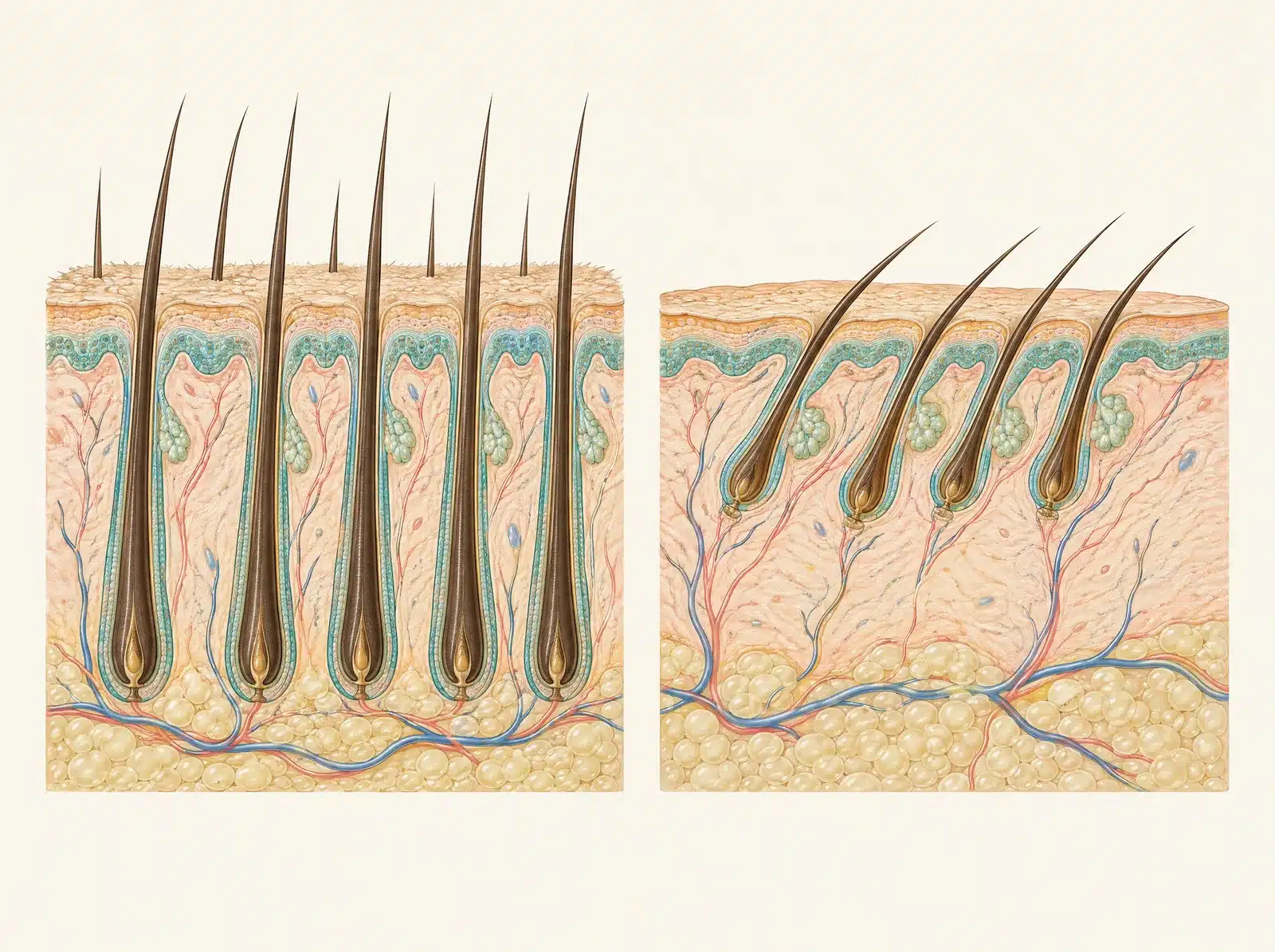
Cross-section of the scalp in two parts: the donor area with evenly spaced follicles, the recipient area with a few follicles implanted at an angle.

Before and after the operation

  • The right time – operating too early can use up the supply of hair and compromise the long-term result, according to StatPearls. The guide When should you have a hair transplant? helps you choose the right time.
  • Ongoing baldness – the grafts keep their resistance, but the neighbouring original hairs may continue to fall out. In a study from the Indian Journal of Plastic Surgery covering 2,896 patients, only 26 were unhappy (fewer than 1 in 100), because of the loss of non-transplanted hair.
  • Aftercare – good scalp hygiene limits the risk of infection, according to the 2026 review. Your clinic’s instructions are there for that purpose: Washing your hair after a transplant.
  • Your general health – smoking and diabetes can slow growth, according to the Journal of Cutaneous and Aesthetic Surgery. A 2026 review recommends stopping smoking before the operation; follow your clinic’s instructions on this point (at Klineva, 2 weeks beforehand).
  • Realistic expectations – a transplant redistributes hair; it does not create it. The American Academy of Dermatology sums it up like this: a full head of hair may be unrealistic, but fuller hair is a realistic goal.

A failed hair transplant in Turkey: what you need to know

Online, a search for ‘failed hair transplant Turkey’ mostly brings up negative accounts: satisfied patients generally write less than the others. To our knowledge, no independent statistics compare countries. A review published in 2025 in Aesthetic Plastic Surgery acknowledges that some centres achieve good results in Turkey, with a high graft survival rate. What matters is the clinic you choose and what it actually does for you.

Empty, spotless treatment room seen from above: a reclining chair, a table of neatly arranged instruments and a shelf of files.

In Turkey, a regulation on hair transplant units governs the practice: the procedure takes place in a unit authorised by the Ministry of Health, with certified staff, and the patient signs informed consent.

Internationally, the ISHRS states that some of the tasks may be delegated to an authorised healthcare professional, with your agreement. A reputable clinic simply explains who does what.

How to avoid a failed transplant before you book

The good news: most complications of a hair transplant are avoidable, according to a study of 2,896 patients. A careful examination of the donor and recipient areas and a detailed medical history reduce them. The guide How to choose a clinic in Turkey sets out the selection criteria. There is no need to ask everything: three pointers are enough, and a reputable clinic will give them to you unprompted.

  • A team that answers clearly – it explains who does what and why it recommends this number of grafts for your case.
  • A written quote – number of grafts, technique and what the package includes. Compare like for like, at an equal number of grafts, never on the headline price alone.
  • Results at 12 months or more – real patients, shown from several angles, with the number of grafts.
Open notebook with blank pages, a brass pen, reading glasses, a small plant and a cup of tea on a light oak desk

Two simple habits complement these pointers: talking your plans through with a doctor or other healthcare professional before you travel, as the French foreign ministry (France Diplomatie, in French) also advises, and keeping the quote, the consent form and your photos.

Follow-up matters just as much: the full result can take up to 18 months. At Klineva, an adviser follows your case before you leave, an interpreter accompanies you on site and follow-up continues for 18 months. Another good sign: a clinic that can tell you ‘not yet’ or ‘fewer grafts’ when your case does not allow what you are asking for. According to the ISHRS, a lack of donor hair is a good reason not to operate; these situations (contraindications) are identified during the assessment, before the quote.

A failed transplant: what to do, and in what order?

If you are still unsure after comparing your case with the timeline above, there is no rush, unless there is a complication: take it step by step. If you had your operation at Klineva, write to us: follow-up continues for 18 months.

  1. Work out where you are on the timeline. Count the months since the operation. Before 12 months, and with no sign of complication, patience is part of the process.
  2. Take photos at regular intervals. Once a month, in the same light, at the same distance, from the same angles (front, side, top, back, donor area). These images let a doctor measure progress.
  3. Write to your clinic. Attach your photos and the date of the operation, and ask for a copy of your file: technique, number of grafts and areas, team, photos.
  4. Get a second opinion, in person. Choose, as the American Academy of Dermatology advises, a doctor who understands hair loss and regularly performs hair transplants, a dermatologist for example. They can tell the difference between slow regrowth, progressing baldness and a complication.
  5. Do nothing irreversible before 12 months, unless there is a complication: no new session, no removal of grafts, no micropigmentation. The ISHRS advises against micropigmentation until at least a year after a transplant.
  6. Treat the cause with a doctor. If baldness is progressing, medical treatment can slow the loss of your original hair, according to the ISHRS. The guide Hair loss treatments: what works, what doesn’t helps you sort through the options. No treatment should be started without medical advice.

Can a failed hair transplant be repaired?

Often in part, depending on each person’s situation. According to the ISHRS, repair is ‘almost a specialty in and of itself’: a doctor who does it regularly will be able to tell you what is realistic in your case.

Ceramic bowl repaired with fine gold seams, resting on a linen cloth with a brush and dried flowers.
SolutionWhat it is forIts limitation
Removing or relocating grafts in a targeted way (FUE technique)Correcting a hairline that is too low or visible tuftsDepends on the supply of hair still available
Adding graftsFilling in thin areasNot possible if the donor area is depleted
Body hair (beard, chest)Topping up when the nape of the neck is no longer enoughImprovements that are moderate at best, according to the IAHRS
Scalp micropigmentationCamouflaging a thin area or a scarLasts 5 to 10 years; wait at least 1 year after the transplant
Medical treatmentSlowing the loss of the original hairDoes not regrow hair in a completely bald area

Sources: ISHRS and IAHRS. The choice depends on your case and your donor area.

Your situation, your next step

  • Transplanted less than 12 months ago, with no pain or fever – be patient, photograph your scalp every month and compare it with the timeline in this guide.
  • Transplanted more than 12 months ago, and disappointed – ask for a second opinion in person before any decision, then look at the solutions with a doctor who regularly performs repair surgery.
  • Not transplanted yet – take your time, ask your questions and compare the answers before you compare prices.

Whatever your situation, you are not alone: send your photos through our free diagnosis and an adviser will get back to you within 24 hours with a first opinion based on your photos, with no deposit required. It does not replace an in-person examination, but it helps you see where you stand. Klineva has been supporting French-speaking patients for 10 years, 9,000 in total.

Wooden desk seen from above: hand mirror, phone propped against books, open notebook and pencil, cup of tea, in watercolour.

In brief

  • Normal shedding. Transplanted hairs fall out between 2 and 8 weeks after the operation: the root stays in place, and shock-loss is temporary.
  • Timeline. First new hairs generally from the 3rd month, result visible between 6 and 9 months for most people, complete between 12 and 18 months.
  • Genuine signs. Unnatural-looking hairline, thinned donor area, wide scars, uneven surface, infection, low density after 12 months.
  • Causes. A poorly thought-out plan, too many grafts for the donor area, damaged grafts, fragile aftercare or general health, ongoing baldness.
  • Avoiding it. A reputable clinic explains who does what, justifies the number of grafts, states its authorisation and shows results at 12 months.
  • What to do. Be patient if there is no complication, take photos every month, ask for a second opinion, do nothing irreversible before 12 months. Klineva is with you.

A selection of Klineva hair transplant results

real patients, with the number of grafts and the time elapsed since surgery

See all our results
Free diagnosis

Thinking about a hair transplant?

Leave us your number: an adviser will get back to you within 24 hours. We’ll ask for the photos for your diagnosis after this first conversation, by WhatsApp or email.

We’ll call you back within 24 hours

    Frequently asked questions

    01

    How many hair transplants fail?

    To our knowledge, there is no reliable failure rate by clinic or by country. A 2026 review cites complication rates of 1.2% to 4.7% in large published series, with serious complications being rare. A systematic review of 45 publications, published in 2025, concludes that hair transplantation is generally safe: pain and swelling of the donor area are the most commonly reported problems. Minor annoyances (scabs, forehead swelling, pimples) are much more common, according to a literature review published in Aesthetic Plastic Surgery. These figures describe published series, not your clinic.

    02

    Can hair be transplanted onto a scar?

    In the majority of cases, yes, according to the ISHRS, provided the skin has a good enough blood supply: a follicle needs blood to survive. The doctor assesses the quality of the scar and may start with a few test grafts.

    03

    Can you have a second hair transplant in the same place?

    Sometimes. A touch-up is not decided on until growth has finished, at around 12 months according to a 2026 review. It then depends on the supply of hair still available.

    04

    Can transplanted hairs fall out for good?

    Grafts are generally permanent, because they keep the resistance of the donor area. In a large series of 2,896 patients, only 5 lost some of their transplanted hair. What tends to keep falling out is the neighbouring original hair. That is why it is worth talking to a doctor, who may suggest a long-term treatment and, sometimes, a second session.

    05

    Pimples and redness after a hair transplant: should you be worried?

    Inflammation of the follicles (folliculitis) is common. It is the most commonly reported complication in a series of 2,896 patients (203 cases), lasting 3 weeks to 3 months. A true infection is rare: fewer than 1 case in 100 in most studies, according to a 2026 review. If the pimples come with pain, discharge or fever, call your clinic the same day and see a doctor. If they persist, write to your clinic.

    Sources

    1. American Academy of Dermatology (AAD): ‘Hair transplant’ · page with no date displayed, accessed in October 2026
    2. ISHRS: six other pages (FUE, baldness, scars, questions, alert) · pages dated from January 2024 to January 2026
    3. StatPearls (American medical library): Hair Transplantation · updated on 2 August 2025
    4. Frontiers in Medicine: complications of FUE hair transplantation (review, 2026) · 3 February 2026
    5. NHS (UK National Health Service): ‘Hair transplant’ page · page reviewed on 29 September 2023
    6. ISHRS: ‘Revising previous hair transplants’ (repairing a transplant) · updated on 6 May 2026
    7. Journal of Cutaneous and Aesthetic Surgery: complications of hair transplantation · 1 December 2017
    8. Indian Journal of Plastic Surgery: 2,896 patients operated on over 10 years · 31 December 2021
    9. Aesthetic Plastic Surgery: hair transplant tourism, ‘Allures and Alarms’ · 14 July 2025
    10. Lexpera: current text of the Turkish regulation on hair transplant units · version amended on 12 September 2025
    11. Turkish regulation: Ministry of Health, Official Gazette, Anadolu Agency · 6 May 2023; amended on 12 September 2025
    12. ISHRS: ‘FAQs: hair transplant black market’ (delegation of tasks) · updated on 16 September 2026
    13. France Diplomatie: Turkey, travel advice, health section (in French) · updated on 15 September 2026
    14. IAHRS: ‘Repair surgery’, surgery to repair a hair transplant · page with no date displayed, accessed in October 2026
    15. Aesthetic Plastic Surgery: two reviews on complications (2025) · literature review (vol. 49) and systematic review of 5 September 2025

    The text of the Turkish regulation is published in Turkish; the journals and learned societies publish in English. Pages accessed in October 2026.

    WhatsApp
    Got a question? We'll be in touch!

    We look forward to hearing from you. Fill in the form and we'll get back to you as soon as possible.